
- Hebei Shenglei Insulation Materials Co., Ltd.
- WhatsApp:8616630881129
- Email: loraasmv@hotmail.com
- Tel: 8616630881129
Author:Shenglei Time:2026-09-16 11:48:15 Number of views:84Second-rate
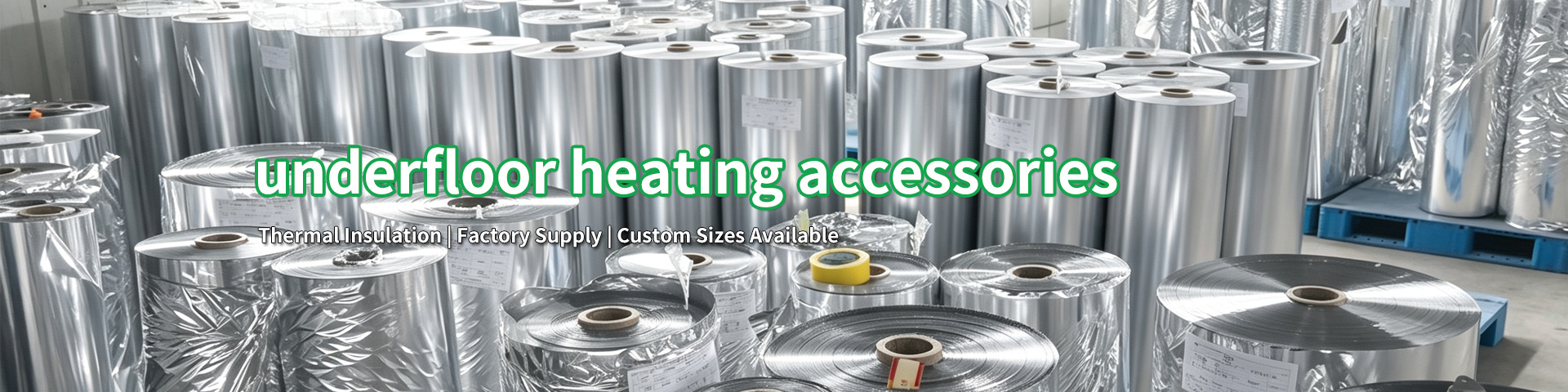
Mirror reflective film for underfloor heating is a highly reflective layer used as part of a floor heating construction to help manage radiant heat transfer. It is typically made from a reflective polymer film, metallized film, or aluminum-based layer with a bright, mirror-like surface.
The reflective surface has low emissivity, meaning it emits relatively little thermal radiation. When properly incorporated into a floor construction with an appropriate air space or insulation layer, the reflective surface can reduce radiative heat transfer toward the lower part of the floor structure. Research on reflective insulation shows that the thermal effect depends strongly on the reflective surface, adjacent air spaces, and the overall floor construction.
In a typical underfloor heating system, hot water circulates through heating pipes installed beneath the finished floor. Heat is transferred from the pipes through the surrounding floor layers and ultimately to the room above.
A mirror reflective film can be incorporated into the floor assembly as a reflective layer. Its low-emissivity surface reduces the amount of radiant heat exchanged across an adjacent air space, helping control heat transfer through the floor structure.
It is important to distinguish reflective film from conventional bulk insulation. A reflective layer primarily addresses radiative heat transfer, while materials such as EPS, XPS, mineral wool, or other insulation boards primarily resist heat transfer through conduction and convection.
Mirror reflective film can be used in underfloor heating systems to:
Provide a reflective surface beneath or around heating components
Help manage radiant heat transfer
Support heat distribution within certain lightweight floor constructions
Separate or identify heating pipe layouts when printed with grid markings
Work together with insulation materials in a floor heating assembly
Provide a thin reflective layer where installation space is limited
Research on lightweight radiant floor systems has also examined aluminum foil and other heat-spreading layers as components of floor heating constructions.
Not necessarily.
Mirror reflective film is a broader term that can describe a highly reflective film with a metallized or aluminum-based surface. Aluminum foil is a specific metallic material.
Depending on the actual product structure, suitable terminology may include:
Underfloor Heating Reflective Film
Mirror Reflective Film for Underfloor Heating
Underfloor Heating Reflective Foil
Underfloor Heating Aluminum Foil
High Reflective Underfloor Heating Film
Radiant Floor Heating Reflective Film
Underfloor Heating Heat Reflective Film
For a product with a visibly mirror-like reflective surface, Mirror Reflective Film for Underfloor Heating can be used as a descriptive product keyword, while Underfloor Heating Reflective Film is a broader SEO term.
A highly reflective surface generally has low emissivity. This is important because reflective insulation systems work by reducing radiative heat transfer across an adjacent air space. However, the performance of the complete floor assembly depends on factors such as emissivity, air-gap thickness, insulation, installation orientation, and surrounding materials.
Therefore, a mirror reflective film should normally be considered one component of an underfloor heating system, rather than a replacement for conventional thermal insulation.
The exact position depends on the floor heating construction. It may be incorporated with:
Underfloor heating insulation boards
Hydronic floor heating systems
Lightweight radiant floor systems
Heating pipe installation layers
Reflective insulation assemblies
Dry underfloor heating systems
In lightweight radiant floor systems, reflective or aluminum layers may also be used as part of the heat-transfer structure. Studies have investigated floor constructions incorporating aluminum layers together with heating pipes and insulation.
Mirror reflective film for underfloor heating is a thin, highly reflective layer designed to help control radiant heat transfer within a floor heating assembly. Its low-emissivity surface can reduce radiative heat exchange across an appropriate air space, while the overall thermal performance depends on the complete floor construction.
For SEO content, Underfloor Heating Reflective Film can be used as the primary product term, with Mirror Reflective Film for Underfloor Heating, High Reflective Underfloor Heating Film, and Underfloor Heating Reflective Foil as related keywords.
Tenpierik, M. J., & Hasselaar, E. (2013). Reflective multi-foil insulations for buildings: A review. Energy and Buildings, 56, 209–218.
Escudero, C., Martin, K., Erkoreka, A., Flores, I., & Sala, J. M. (2013). Experimental thermal characterization of radiant barriers for building insulation. Energy and Buildings, 59, 62–72.
Thermal insulation performance of reflective foils in floor cavities – Hot box measurements and calculations. Energy Procedia, 132, 333–338.
Experimental and numerical analysis of lightweight radiant floor heating system. Energy and Buildings.
Copyright © 2026-2027 Hebei Shenglei Insulation Materials Co., Ltd. All Rights Reserved