Underfloor Heating Staples: Single and Continuous Strips
Author:shenglei Time:2026-09-30 16:23:13 Number of views:50Second-rate
Underfloor Heating Staples: Single vs Continuous Staple Strips
Underfloor heating has moved from a luxury option to a standard expectation in new builds and renovations, and the small components that hold it in place matter more than their size suggests. Before the screed is poured, every heating pipe must sit exactly where the design specifies, pressed against the insulation layer so the system performs as calculated.
The staples and staple strips used for this job look trivial, yet they decide whether a pipe drifts during the pour and whether the floor later heats evenly. This article compares the two main fixing formats the supplier offers: discrete single staples and continuous plastic staple strips.
What underfloor heating staples actually do
The pipe circuit snakes across the insulation board. Staples clip directly over the pipe, pinning it to the EPS or XPS insulation below.
A good fix keeps the pipe from floating into the screed, from shifting when it is pumped, and from creeping at the bends where tension is highest. The factory's fixing staples are sized so the leg drives cleanly into the board without crushing the pipe wall.
Single staples versus continuous staple strips
Single staples are individual clips, each pressed to pin one point of the pipe. They suit curved runs and tight radii where a continuous strip would force the pipe off its line, and the installer places them only where needed, so waste stays low.
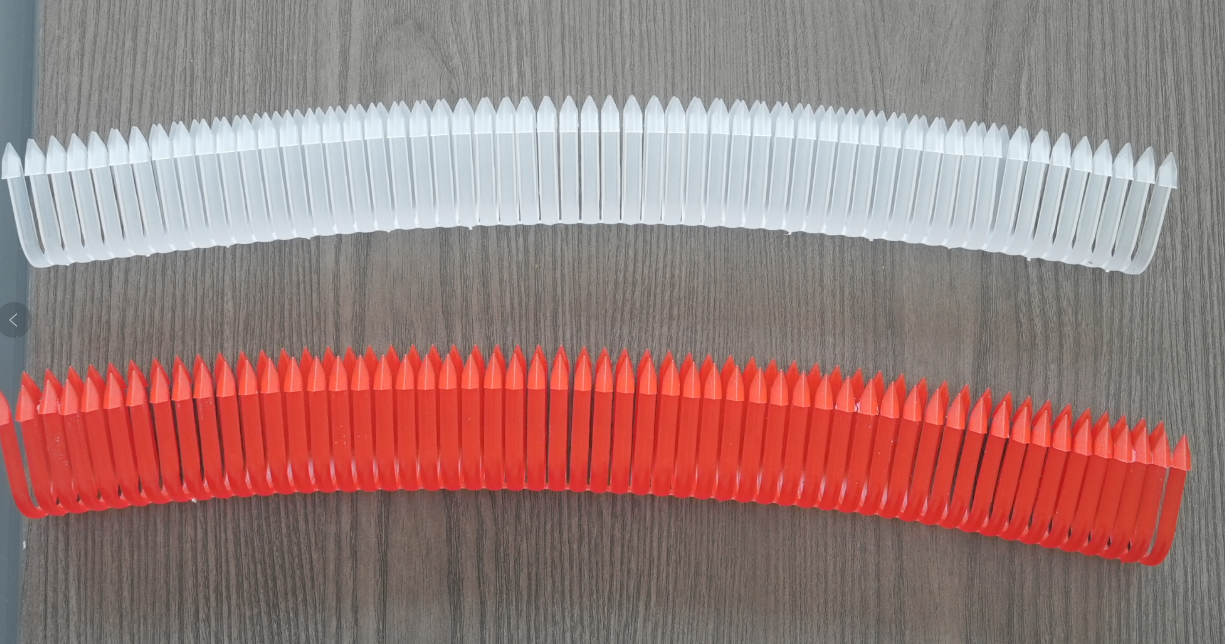
Continuous staple strips are long plastic rails with pre-formed clips at a regular pitch. The installer snaps the strip to the board and tucks the pipe into each clip as the run progresses, which speeds long straight runs and guarantees even spacing.
The trade-off is flexibility: a strip commits the pipe to a fixed geometry, while single staples let the installer follow any layout by eye.
Materials and holding strength
Single staples come in galvanised steel wire or moulded plastic, and each behaves differently in the screed. Steel holds a firmer bite and resists the uplift of a pumped screed, but it must stay corrosion resistant where the floor may see moisture. Plastic staples are lighter, non-corrosive and quiet to handle, and suit EPS boards where a thin leg penetrates without splitting the sheet.
Continuous strips are almost always plastic, made as one extruded profile with integrated clips. Holding strength depends less on the clip and more on how deep the leg seats in the insulation. The supplier matches staple length and wire gauge to the board density the customer specifies.
Choosing staples for different pipe and insulation types
Pipe diameter drives the clip size. A 16 mm pipe needs a narrower saddle than a 20 mm pipe, and mixing them on one job means keeping both staple sizes on site. Insulation type drives leg length: soft EPS takes a shorter leg, while dense XPS or thin panels need a longer leg to reach a secure depth.
Where the insulation is bonded to a vapour barrier or aluminium foil, the staple must pierce cleanly without tearing the moisture layer. The manufacturer advises sampling the staple on an offcut of the actual board before a full lay, since density varies between batches.
Installation technique and common mistakes
Drive each staple square to the board so both legs seat evenly; a skewed staple holds on one leg and the pipe lifts on the other. Keep clips close at bends, where the pipe tries to straighten and pull free, and space them wider on straight runs where tension is low.
A frequent mistake is stretching the pipe tight and fixing it under tension, which lets it contract and pop the staples once warm. Crews should also avoid driving staples through the pipe; the clip must sit over it, not pierce it.
The factory's single staples are shaped so the wire arches over the pipe rather than cutting it, which removes that risk when used as intended.
Compatibility with manifolds and screed
Near the manifold the pipe enters and leaves in tight groups, and continuous strips rarely fit the cramped geometry. Single staples handle this zone, holding each pipe at a fixed offset so the bundle stays ordered and the connections stay accessible.
As the screed goes down, the fixing must survive the flow and weight of the pour; strips and staples rated for this resist being swept aside by a levelling bar. The supplier can supply both formats in one consignment so the installer is never waiting on a second shipment mid-floor.
How a manufacturer supplying staples and fixing accessories supports installers
Buying staples and fixing accessories from one source changes the job site. The factory that moulds the strip also manufactures the single staples and the fixing staples, so clip pitch, leg length and colour stay consistent across the order. That consistency removes the guessing when crews switch between formats on the same floor.
Export customers get the products packed to survive long transit, with customization available on staple length, wire gauge and strip pitch to suit local pipe and board standards. A distributor can stock one line rather than juggling several brands, and the supplier supports OEM labelling. Hebei Shenglei Thermal Insulation Materials Co., Ltd. runs this combined supply from Hejian, Hebei, pairing the staples with the insulation boards and accessories the same floor needs, which keeps a single point of accountability from manufacture to the poured slab.
References
BS EN 1264-4:2008. Water based surface embedded heating and cooling systems - Part 4: Installation. CEN.
BS EN 1264-2:2008. Water based surface embedded heating and cooling systems - Part 2: Floor heating: Prove methods for the determination of the thermal output. CEN.
BS 8204-1:2002+A1:2009. Screeds, bases and in-situ floorings - Part 1: Concrete bases and screeds. BSI.