Underfloor Heating Film: Mirror vs Aluminum vs Foil Underlay
Author:shenglei Time:2026-09-30 17:05:34 Number of views:199Second-rate
Underfloor Heating Reflective Film: Mirror, Aluminum and Underlay Compared
The reflective layer beneath a wet or dry underfloor heating system does more than most buyers expect. It directs radiant heat upward into the room instead of letting it leak into the subfloor, and a small change in film choice can shift both comfort and running cost.
Each option reflects heat, but the materials, durability and price differ enough to matter on a real project. This guide compares how the three films perform and where each fits best.
Why reflective layer choice matters
A reflective layer sits between the heating pipe or cable and the subfloor, forming a low-emissivity barrier. Without it, heat radiates downward into concrete or screed and is lost, doing nothing for the occupant. The right film recovers that energy and shortens warm-up time.
Choice also affects installation. Some films double as a protective layer for boards, while others bond with underlay to save a step. Spec errors where a film rated for one floor is used on another are common and costly to fix.
Heat output, response speed and lifetime all trace back to the film, so buyers should treat the reflective layer as a performance component rather than a commodity roll.
Mirror finish film
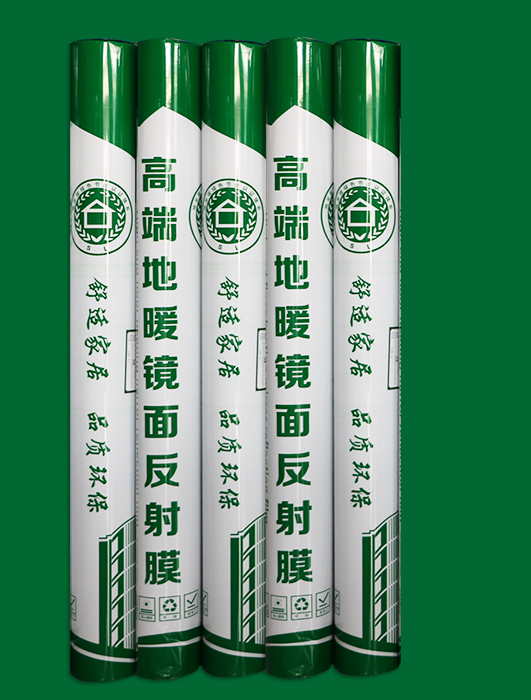
Mirror finish film uses a vacuum-metallised or laminated high-gloss surface that scatters very little light and reflects a high share of radiant heat. The manufacturer produces it as a thin, flexible sheet that pairs well with polystyrene or XPS insulation panels.
Its main advantage is reflectivity at a low price. For suspended timber or insulated slabs where the film is protected from abrasion, mirror finish performs close to more expensive options. It is light and easy to cut on site.
The trade-off is fragility. The gloss surface scratches during handling and offers little mechanical protection on its own. Distributors recommend it where a separate underlay already provides the cushioning.
Pure aluminum reflective film
Pure aluminum reflective film replaces the metallised coating with a genuine aluminum layer, usually bonded to a reinforced backing. The result is a tougher, more stable reflector that resists tearing and keeps its performance through repeated site traffic and temperature cycling.
Because the aluminum is a real metal rather than a printed sheen, reflectivity holds up better over time and the surface tolerates moisture without degrading. The factory often supplies this grade for damp spaces such as basements.
Cost sits above mirror finish, but so does reliability. Specifiers choosing aluminum film typically value consistency across large floor areas, where a weak point would show up as a cold patch after commissioning.
Foil underlay
Foil underlay combines the reflective foil with a backing such as foam or fleece, so one product delivers insulation, a vapour check and a reflective face. The supplier offers it for floating floors and renovation jobs.
Its strength is integration. A single roll lays down cushioning, dampens minor subfloor unevenness and reflects heat upward, which trims both labour and material lines. For laminate or engineered wood over UFH, foil underlay is a common default.
The caution is thickness. A bulky underlay can slow the system's response and trap less heat near the surface than a thin film over a dense board. Match its thermal resistance to the build-up rather than assuming thicker is better.
Performance and cost trade-offs
On pure reflectivity, mirror and aluminum grades lead, with foil underlay close behind once its backing is accounted for. The gap widens on durability: aluminum outlasts mirror finish, and foil underlay trades some thermal speed for built-in cushioning and vapour control.
Budget follows the same order. Mirror finish is the lean choice for protected installs, aluminum sits in the middle with a long-life premium, and foil underlay can be cost-neutral when it removes a separate underlay line.
No single film wins everywhere. The sensible move is to rank priorities: peak reflectivity, build simplicity, moisture resistance or lifetime, then pick the grade that scores highest without overspending on features the floor will never use.
Matching film to floor type
For tiles over screed with a separate insulation layer, a thin mirror or aluminum film reflects well and adds negligible height. Where the build uses insulated panels, the manufacturer pairs the panel with its matched film to avoid gaps at the joints.
Floating timber and laminate favour foil underlay, which cushions the board and reflects in one step. Basements and wet rooms lean toward pure aluminum for its moisture stability. Renovation with limited height calls for the thinnest reflector that still performs.
Get this match wrong and the symptom is a floor that heats unevenly or slowly. A short call with the supplier before ordering prevents most of those field complaints and keeps the warranty position clean.
How a manufacturer supplying film ranges supports buyers
Buyers gain most when the factory can supply the whole film range rather than a single grade. One source means consistent roll widths, matched accessories, and a single contact for technical questions and lead times.
Hebei Shenglei Thermal Insulation Materials Co., Ltd. supports this approach by manufacturing the three films alongside UFH insulation and fixing accessories, and by offering OEM and customization for roll size, printing and private label. With export rights and in-house production, the supplier can pack mixed grades on one shipment and adjust volumes to a project's phasing.
For distributors and contractors, that breadth removes the need to qualify several vendors and reduces the risk of mismatched components on site. The factory's ability to bundle film, insulation and fixings into one consignment turns a commodity purchase into a managed supply line.
References
BS EN 1264-4:2008. Water based surface embedded heating and cooling systems — Part 4: Installation. CEN.
BS 8204-1:2002+A1:2009. Screeds, bases and in-situ floorings — Part 1: Concrete bases and screeds. BSI.
BS EN 12828:2012+A1:2014. Heating systems in buildings — Design of heat distribution systems. BSI.